
Enterprise AI Platform

Foundation for Frontier Transformation

Enterprise AI Platform Development at Scale

A fully secured, governed, and production-ready AI platform — with a modernized data estate — engineered to support enterprise multi-agent use cases at scale.

The Challenge

Enterprises that want to operationalize agentic AI face a foundational problem: they don't have a platform to build on. They have applications. They have data — scattered across internal systems, vendor platforms, partner feeds, and legacy databases. And they have ambition. What they lack is the governed, production-grade layer that turns all of that into a surface where multi-agent use cases can be developed, deployed, and trusted at scale.

The barriers are structural:

  • No unified data foundation — Enterprise data lives in silos — across internal applications, third-party vendor systems, partner integrations, and legacy stores. Without a modernized, governed data estate, agents have nothing trustworthy to reason over. Data quality, lineage, and access control are prerequisites, not features.

  • Governance is missing, not optional — Agents that touch production data, execute actions on behalf of users, or interact with external systems require enterprise-grade security: per-user entitlements, least-privilege enforcement, full audit trails, and sensitive-data redaction. Most organizations don't have this layer. Without it, agentic use cases cannot move beyond sandboxed demos.

  • Intellectual property at risk — Production AI platforms handle proprietary data, trade secrets, and competitive intelligence. Without architectural controls for data isolation, redaction, classification, and access governance, deploying agents at scale creates unacceptable IP exposure.

  • Pilots don't become platforms — A proof-of-concept for one use case is a project. A governed platform that supports dozens of multi-agent use cases across applications and domains is an asset. The gap between the two is architecture, not ambition — and most AI engagements never cross it.

  • Cost control is an architecture decision — Without token budgeting, adaptive context trimming, and workflow optimization engineered into the platform, AI consumption costs are unpredictable. Unpredictable costs don't survive executive review — and they certainly don't scale to enterprise-wide deployment.

  •  Use cases vary; the platform shouldn't — Every enterprise has different agentic use cases — operations automation, cross-system intelligence, field-workforce augmentation, document reasoning, compliance workflows. Building a bespoke solution for each one is unsustainable. What's needed is a common, governed platform that any use case can be built on.

Top 3 Challenges

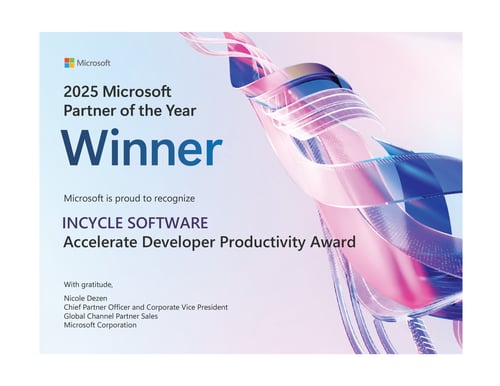
InCycle recognized by Microsoft for a 9th time and claims global award.

InCycle Named 2025 Global Microsoft Partner of the Year!

InCycle Recognized by Microsoft for AI-First Innovation

We are proud to share that InCycle Software has been recognized as the 2025 Microsoft Accelerate Developer Productivity Partner of the Year—a distinguished global honor that underscores our leadership in AI-powered innovation. This achievement reflects our commitment to helping organizations modernize and adopt AI at scale. 

 >>> Press Release and Microsoft Award Announcement<<<

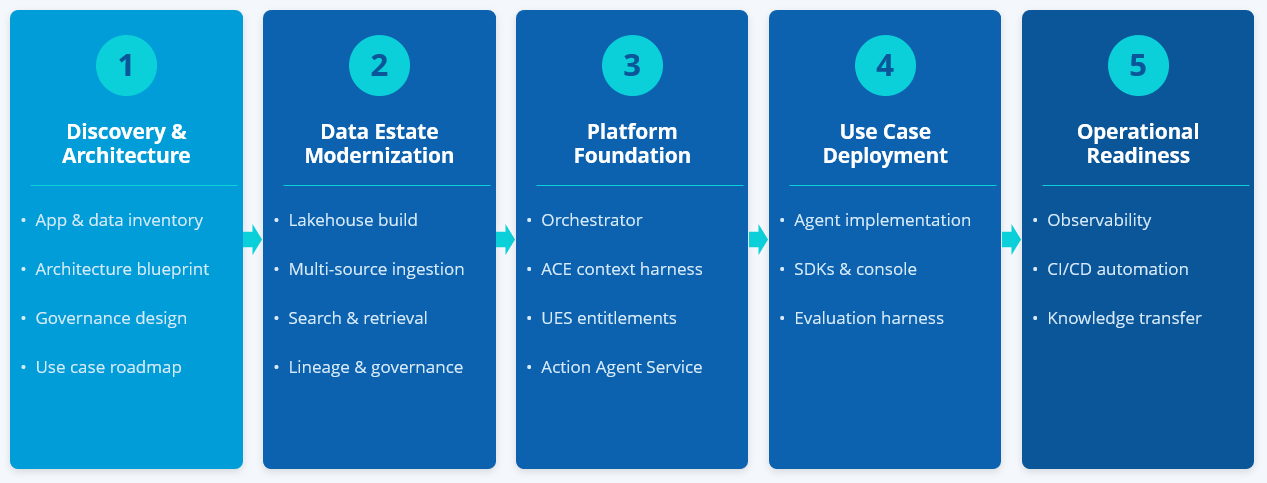
From Discovery to Production

InCycle delivers a production-grade, multi-agent AI platform built entirely on Microsoft Azure. The platform doesn't just answer questions — it reasons, retrieves, acts, and reflects across every connected system, under the user's own permissions, with full auditability and cost control. All our enterprise AI Platform engagements are designed to deliver measurable, high-impact business outcomes — not theoretical value. A structured, milestone-gated engagement — governance first, agentic value on top. Every phase delivers measurable progress., target outcomes include:

This is not a single-use-case build. It is the governed infrastructure that every use case runs on:

  • A modernized data estate that consolidates data from internal applications, vendor systems, partner feeds, and legacy sources into a governed, agent-ready foundation

  • A multi-agent orchestration layer with planning, reflection, and grounded composition

  • Enterprise-grade security, entitlements, and IP protection enforced on every agent action

  • Cost control and observability engineered into the platform, not bolted on after

  • A governed tool integration layer that exposes enterprise systems to agents through consistent, auditable interfaces

Your teams build use cases on top. The platform handles security, governance, IP protection, cost, and operational readiness underneath.

Operational Excellence

  • Governed by default — Every action under real user permissions (act-as-user, deny-by-default, fail-closed), with full audit trails and explainable access decisions.

  • Cost predictability — Token budgets, adaptive trimming, and workflow promotion convert unpredictable AI spend into a planned, optimizable line item.

  • Observability from day one — Per-step tracing, golden-plan regression tests, and deterministic reproducibility — agent behavior that engineering teams can debug, certify, and trust.

  • Extend without re-architecting — The same governed pattern (Orchestrator, ACE, UES, Action Agent Service, MCP) extends to every new application, domain, and business unit. 

Learn more: Meet with a solution specialist

Book Call


Agentic Platform on Azure

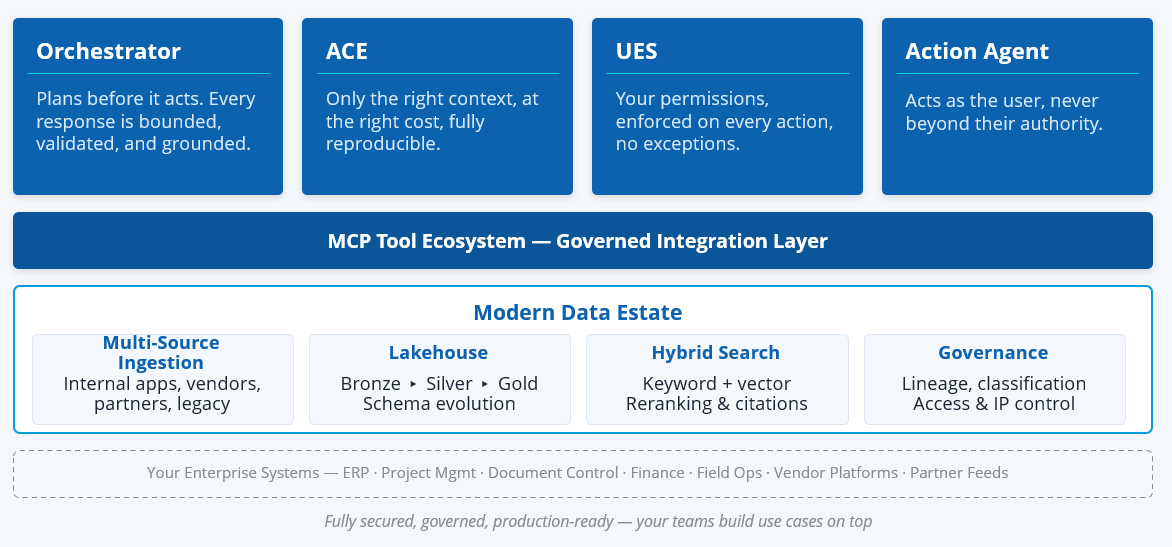
Four core components, governed integration, modern data estate


The platform is built on four purpose-engineered components, each addressing a known enterprise failure mode:


100% Microsoft Azure, end to end:

InCycle Accelerators (IP):

  • Microsoft Foundry — agentic runtime and model orchestration
  • Azure OpenAI — GPT-5.x models for reasoning, planning, and composition

  • Azure AI Search — hybrid retrieval (BM25 + vector) with reranking and citations

  • Azure Web Apps — scalable, isolated agent runtime

  • Microsoft Fabric  — modern data estate (lakehouse, bronze/silver/gold)

  • Model Context Protocol (MCP) — governed tool integration layer

InCycle's proprietary IP makes every engagement faster.
  1. Observability & Test Console — Purpose-built tooling to trace, replay, and regression-test agent runs — plan, tool calls, and composition — turning opaque agent behavior into something engineers can debug, certify, and trust.
  2. Knowledge-Graph Domain-Capture Tool — Accelerates onboarding of each new domain by capturing entities, relationships, and rules into a structured graph that feeds entitlements, retrieval hints, and activity taxonomy — cutting weeks from every new application integration.

Learn more: Meet with a solution specialist

Book Call


NEXT STEP

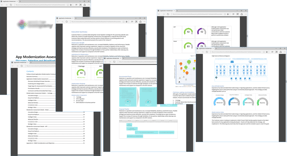
Request AI Platform Readiness Assessment


Funded by:

Microsoft Logo


 To explore how this offering applies to your enterprise, contact InCycle to schedule a discovery conversation. Every engagement begins with a focused assessment of your application estate, data readiness, and highest-value agentic scenarios — so the platform we build is scoped to your outcomes, not a generic template.


Microsoft Azure Cloud Strategy and Roadmap